
Unibloom Sustainability Report 2025 - Enabling companies to choose the right climate actions, affordable and faster
Sustainability Reporting

Unibloom Sustainability Report 2025
This integrated sustainability report aims to share the result of Unibloom’s 2025 carbon footprint and the sustainability work that we have committed to. As a result of this, we hope that we can inspire more companies to publish, not only their carbon emissions, but also share their gaps and actions towards future targets to become an operation in line with Paris Agreements 1.5 C.
Unibloom is a data and intelligence engine (AI), providing procurement, supplier, innovation, sales, and sustainability teams with secondary science backed data across supply chain and data-driven insights into cost, climate impact, and performance. By identifying and comparing ingredients, materials, transportation, energy and packaging alternatives and innovative solutions, we deliver actionable data and recommendations that enable informed sourcing and innovation decisions, faster and affordable for companies with complex supply chains.
Our platform automatically compares and gives recommendations to support the shift to more sustainable and cost-efficient choices for procurement and innovation teams, who has committed to BCorp, Science Based Targets or decided to win new customers who require more transparent and low climate intense suppliers.
The 2023 baseline year had an emission of 19.2 tCO2e. The following year had an increased total carbon footprint of 47.6 tCO2e. This change was mainly driven by an expansion of both the team and investments into data and software solutions to develop our product. In 2024, 100% of the emissions were scope 3, 92.2% of which was from Purchased Goods and Services.
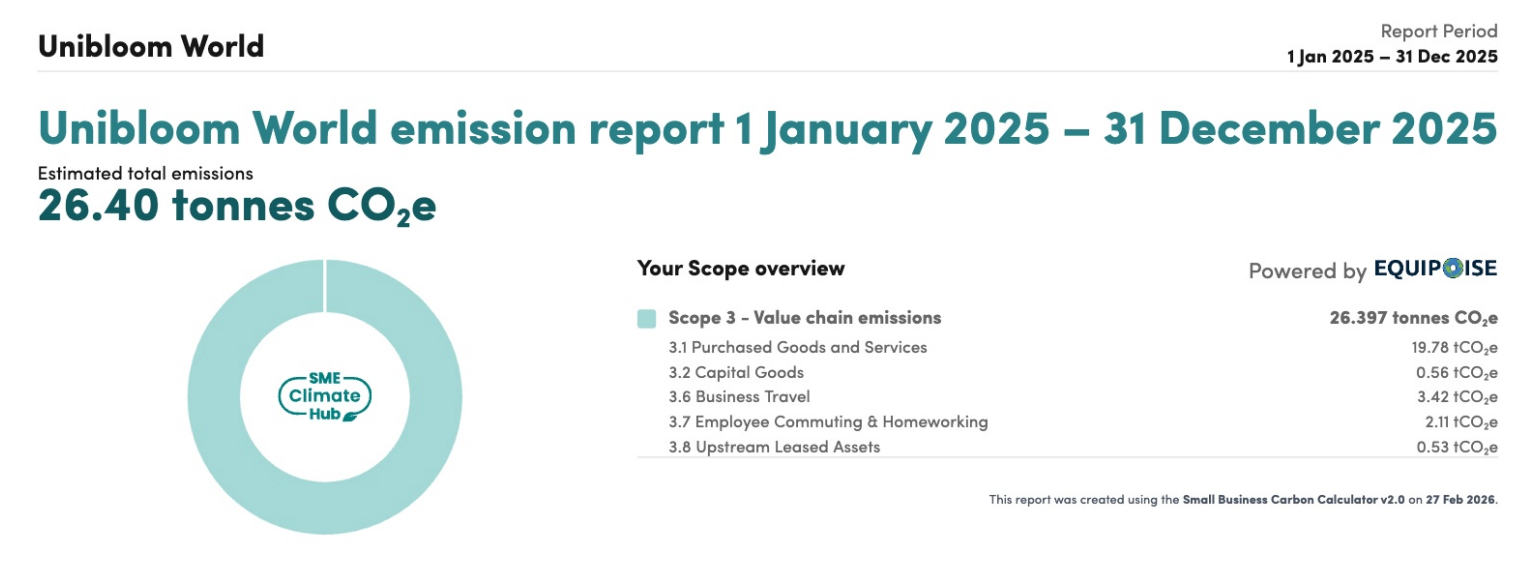
For 2025, our total carbon footprint is 26,4 tCO2e, (Which equals about 40–45 return car trips between Stockholm and Amsterdam or 2,200 servings of 200 g beef.) which is a decrease by almost 50% compared to 2024.
Targets & commitments
In the coming year, our goal is to sustain zero emissions across Scope 1 and Scope 2. As Scope 3 has been our largest source of emissions since the 2023 baseline, we will prioritise actions to reduce and manage these impacts. At the same time, we will continue strengthening our commitment to and alignment with B Corp values throughout the organisation.
We have three key commitments; a target, a pledge, and a certification, that guide our work and hold us accountable for our actions.
SBTi
In September 2024, Unibloom established a near-term Science Based Target for Scope 1 and Scope 2 emissions, meaning that the company has committed to making ambitious and measurable emissions reductions within the next 5–10 years, aligned with the 1.5°C Paris aligned climate pathway. The target uses 2023 as the base year and aims to achieve the defined emissions reductions by 2030, focused on maintenance of zero emissions in Scope 1 and and Scope 2.
Net Zero Pledge
By committing to the Net Zero Pledge, we pledge to deliver greenhouse gas reductions in line with Science Based Targets’ 1.5°C climate change scenario, as well as publicly report greenhouse gas emissions and progress against this target each year. We also commit to publish one piece of research each year on practical steps to delivering an economy in line with climate science.
B Corp
Since April 2025, Unibloom has been a certified B Corp. Being a B Corp is shaping the whole business - from the stakeholder-informed decision-making and transparent public reporting to ethics and culture. We have a diverse team of leaders in AI, sustainability, climate science, procurement, and data, committed to sustainable innovation and fair impact. We have a wide variety of different backgrounds, female and men in various ages and the company is spread all over the world - with team members in the United Kingdom, India, Germany and Sweden. Unibloom’s strength lies in the diversity of backgrounds and perspectives on our team.
Unibloom got an overall score of 87.9 after the assessment, which can be compared to the median score for ordinary businesses of 50.9. The result of the evaluation is published online: www.bcorporation.net/en-us/find-a-b-corp/?query=unibloom
&sortBy=companies-production-en-us.

Our action plan
Our core contribution is to equip organisations with science backed, actionable climate, cost and functional data and alternative solutions, digital and cost-effective adaptable climate transition plans and hands-on tools that accelerate the journey from reporting to implementation of climate reduction initiatives - affordable and democratised across the whole organisation. During 2026, we will expand our platform with new benefits and features, including transportation and packaging alternatives and climate initiative ideation, to strengthen companies’ ability to reduce their total climate impact cost efficiently. No leaders will make decisions solely on carbon emissions, they always need a business case which includes risks and costs of inaction - which Unibloom is committed to help the teams to include in the analysis.
We will also develop a marketplace platform for innovative suppliers, enabling them to share verified sustainability, cost and product data and gain visibility on Unibloom Switch Platform. This will allow companies to easily discover, compare, and connect with innovative suppliers, supporting more informed and sustainable sourcing decisions.
This year, we will make greater emphasis on building a strong community to further align our business with B Corp values. In March 2026, we will launch a procurement pioneering club, to create a supportive space where professionals in the field can connect, share knowledge, and help one another to increase the knowledge on how to evaluate suppliers, materials and ingredients, more coherently with data-backed insights across both climate, cost and performance. We will continue our work with strengthening the inclusion for women in tech, data and AI , both by continuing having a high female representation within our company and by actively participating in industry initiatives.
In the following years, we also aim to shift from general-use large language models to building efficient agents specific for our purpose. Our approach to optimising our use of artificial intelligence will reduce water use, energy use, and emissions.
Our challenges
We recognize that the emission from artificial intelligence lifecycle is an energy intensive operation and challenge, and that our biggest source of emission is coming from Scope 3. We also acknowledge that Scope 3 action presents significant challenges for digital, high-growth businesses, particularly due to their limited supplier influence. This is something that we have discussed in our whitepaper Addressing the challenges and opportunities of Science Based Targets for high growth businesses.
As other companies working with developing AI-based products, our key challenges include managing increasing data complexity, ensuring strong AI governance and ethical integrity, scaling technology rapidly and reliably, and navigating global regulatory and policy volatility.
How we report
To report our emissions, we have used the SME Climate hub to calculate our Scope 1, 2 and 3. Last year's numbers come from the Unibloom's 2024 carbon footprint report. Our input data comes from an external accounting firm as well as internal information about traveling and commuting for Scope 3. To calculate the total distance for travelling, we have used the great-circle distance (the shortest path through the air), which is the standard method used in climate calculations.
To conclude, our main impact lies in democratizing access to accurate climate, sustainability, and cost data, along with actionable solutions, at an affordable price, enabling companies of all sizes to accelerate their transition toward a low-carbon and sustainable future - faster and smarter.
By embedding climate considerations into both our operations and our product, we strive to reduce our own footprint while helping others accelerate their transition cost-efficiently and democratised. Through transparent digitised action plans, improved databases and continuous innovation with AI Agents and the innovative supplier marketplace, we aim to demonstrate how companies can work meaningfully with integrated decision making of sustainable initiatives and operations in 2026.
Anna Sandgren,
CEO & Founder, Unibloom World
London, 26/02, 2026


